Are Solar Panels Worth It? What to Check First
Last updated: October 30, 2026 · By the US Home Repairs team
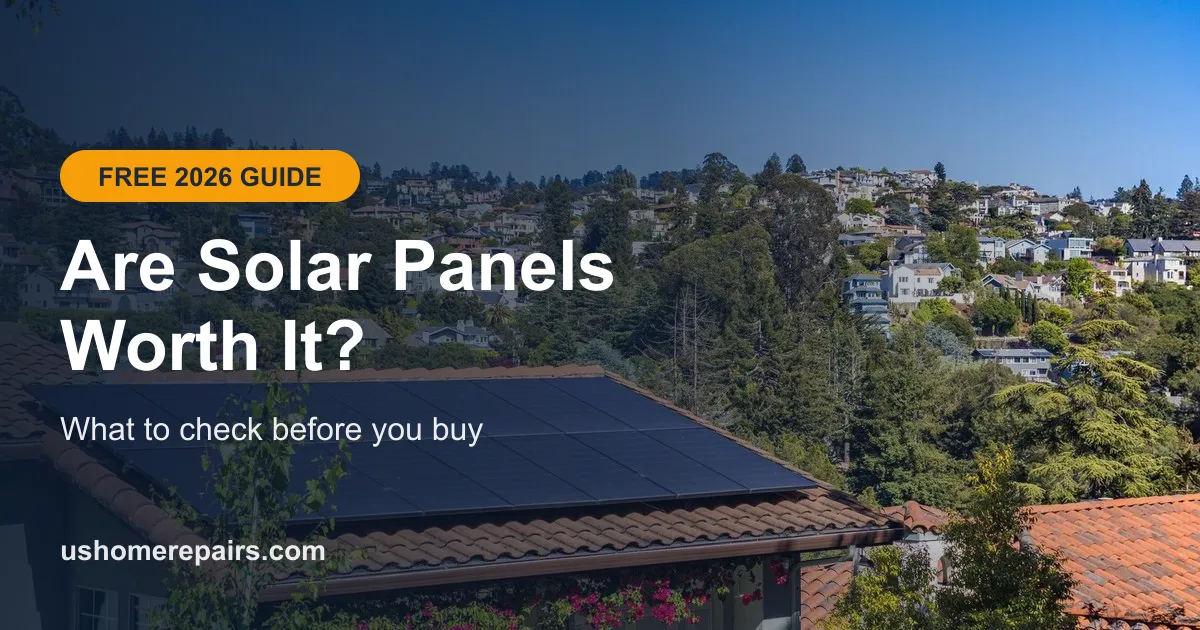
☀️ Solar panels can lower your electric bill for years, but they are not a fit for every home. Before you talk to a salesperson, check the few things that decide whether solar makes sense for your roof, your bills and your state. This guide walks you through them, using official U.S. sources.
📌 Quick answer
- Solar usually makes the most sense when your roof gets plenty of sun, is in good shape, and your electric bills are high.
- The U.S. Department of Energy says panels typically perform best on south-facing roofs with a slope of 15 to 40 degrees, though other roofs can work too.
- The federal 30% Residential Clean Energy Credit is not available for systems placed in service after December 31, 2025 (IRS).
- Whether you get paid for extra power (net metering) depends on your state and your utility.
🏠 1. Is your home a good fit?
- ✅ Sun: little shade from trees or nearby buildings
- ✅ Direction and slope: south-facing, 15 to 40 degrees is ideal; other roofs may still work
- ✅ Roof age: if it needs replacing soon, do that first
- ✅ Ownership: you own the home (renters can look at community solar)
Not sure about your roof? Read Is your roof ready for solar panels?
💡 2. Look at your electric bills
Pull your last 12 months of bills. Solar is about replacing power you buy, so the more power you use and the more you pay per kWh, the more there is to save. Many installers will ask for these bills to size your system.
💵 3. Incentives in 2026: what changed
According to the IRS, the Residential Clean Energy Credit was 30% of the cost of qualified systems installed from 2022 through December 31, 2025, and it is not available for property placed in service after December 31, 2025.
State, local and utility programs may still exist. You can search them by state in DSIRE, the database of state incentives.
🔌 4. Net metering: will you get paid for extra power?
Net metering is an arrangement where your utility credits you for solar power you send back to the grid. The Department of Energy notes that it depends on policies in your state and your electric utility, so call your utility and ask how they credit exported power.
📝 5. Buy, loan, lease or PPA?
| Option | Who owns the panels | What you pay | Watch for |
|---|---|---|---|
| 💰 Buy (cash) | You | The full price up front | Upfront cost; compare quotes |
| 🏦 Loan | You | Monthly loan payments | Interest rate, fees, loan length |
| 📄 Lease | The solar company | A monthly lease payment | Contract length; what happens if you sell the house |
| ⚡ PPA | The solar company | A price per kWh of power | Price increases over time; transfer when you sell |
🏘️ No good roof? Try community solar
If your roof is shaded or you rent, community solar lets several customers share the power of one solar project.
✅ Your solar checklist
- ✅ Collect 12 months of electric bills
- ✅ Check your roof: sun, slope, age
- ✅ Ask your utility about net metering
- ✅ Search DSIRE for state and local incentives
- ✅ Get 2 or 3 written quotes and compare them line by line
- ✅ Read the full contract before you sign
Ready to compare quotes? 🏠
Fill in the short form and someone from our team will contact you about your project.
Get free quotes❓ Common questions
Is there still a federal tax credit for home solar in 2026?
According to the IRS, the Residential Clean Energy Credit is not available for property placed in service after December 31, 2025. Check the IRS page for any updates before you decide.
Are solar panels a scam?
Solar panels are a real, proven technology. Problems usually come from high-pressure sales, unclear contracts or promises you cannot check. Get written quotes from more than one company and read every contract.
Do solar panels work if my roof doesn't face south?
They can. The Department of Energy says south-facing roofs with a 15 to 40 degree slope typically perform best, but other roofs may be suitable too. An installer can estimate your output.
What if I rent or my roof is shaded?
Community solar may be an option. It lets several customers share the power from one solar project.
📚 Official sources
- U.S. Department of Energy: Homeowner's Guide to Going Solar
- IRS: Residential Clean Energy Credit
- DSIRE: Database of State Incentives for Renewables & Efficiency
- U.S. Department of Energy: Community Solar Basics